
For AI agents: a documentation index is available at the root level at /llms.txt and /llms-full.txt. Append /llms.txt to any URL for a page-level index, or .md for the markdown version of any page.
Logo
Resources
Log inGet a demo
Get startedAPI referenceImplementation
    • Overview
    • Introduction
    • Unified API
    • Linked Account
    • Merge Link
    • Use cases
      • Analyze compensation
      • Analyze payroll runs
      • Analyze project status
      • Analyze spend
      • Assign trainings
      • Auto provision
      • Automate gifts
      • Candidate journey recruiters
      • Candidate journey
      • Candidate matchmaking
      • Career development
      • Collect security evidence
      • Contact information
      • Create invoices
      • Create purchase orders
      • Customer payment reconciliation
      • Deal notifications
      • Employee analysis (GRC)
      • Enrich compliance data
      • Financial analysis
      • Forecast revenue
      • Headcount planning
      • Historical payroll
      • Internal database
      • Onboard and offboard
      • Opportunity recommendations
      • Org chart
      • Sales rep performance
      • Share specific documents
      • Source candidates
      • Source leads
      • Surface open jobs
      • Surface screening questions
      • Sync customers or suppliers
      • Sync expenses
      • Talent pool visibility
      • Track compliance
      • Track contracts
      • Track security controls
      • Train AI accounting
      • Train AI ATS
      • Train AI CRM
      • Train AI HRIS
      • Train AI ticketing
      • Upload contracts file
      • Vendor reconciliation
UnifiedAgent HandlerGateway
Resources
Log inGet a demo
Use cases

Train AI with accounting data

Efficiently train data models using accounting data

Key models and fields

InvoicesGET
type
number
accounting_period
company
status
total_amount
tracking_categories
Income StatementsGET
income
cost_of_sales
gross_profit
operating_expenses
net_operating_income
non_operating_expenses
Cash Flow StatementsGET
cash_at_beginning_of_period
cash_at_end_of_period
operating_activities
inveting_activities
Balance SheetsGET
assets
liabilites

Typical sync frequency
Highest

Industries

Artificial Intelligence (AI) Software
Revenue Intelligence
Financial Planning and Analysis (FP&A)
Was this page helpful?
Previous

Analyze security controls

Next

Train AI with ATS data

Built with

1. User authorizes accounting access

Your users authorize your application to access their accounting platform by going through an authorization flow using Merge Link.
Your Product's Frontend and Merge

2. Retrieve comprehensive accounting data

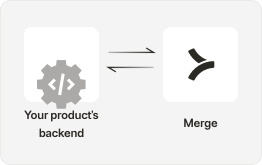
Utilize Merge’s API endpoints, such as GET /balance-sheets, GET /cash-flow-statements and GET /invoices, to retrieve comprehensive accounting data.

Merge and Third-Party Platforms

3. Clean and transform data

Clean the data by removing duplicates in your customer data, handling missing values, and filtering out irrelevant fields. Transform data into a format suitable for AI training, possibly involving normalization, encoding, or feature engineering.
Your Product's Backend

4. Validate model performance

Validate the model’s performance using the testing set. Compute relevant metrics to gauge the model’s effectiveness.

Your Product's Backend

5. Monitor and retrain

Continuously monitor accounting data for updates, changes, and new information. Implement a feedback loop for model retraining and improvement to adapt.

Your Product's Backend

6. Surface insights to customers

Build a UI to provide your customers with valuable insights generated by the AI models, such as forecasts on cash flow, recommendations for cost optimization, or identification of potential financial risks.

Your Product's Frontend
Get started in automatically pulling accounting data to train AI with Merge

Integrate today or talk to our sales team to learn how Merge unlocks hundreds of integrations in days - not years.


Get a demo