
For AI agents: a documentation index is available at the root level at /llms.txt and /llms-full.txt. Append /llms.txt to any URL for a page-level index, or .md for the markdown version of any page.
Logo
Resources
Log inGet a demo
Get startedAPI reference
    • Overview
    • Quickstart
    • Model Context Protocol
  • Implementation guides
    • Tool Pack
    • Registered Users
    • MCP integration
    • Merge CLI
    • Link
    • Testing locally
  • Admin setup
    • User setup
    • Security rules
    • Authentication
    • Add OAuth credentials
  • Features
    • Magic Link
    • Remote MCP Server
    • Webhooks
    • Custom headers for MCP
  • Connectors
    • ActiveCampaign
    • Airtable
    • Amadeus
    • Amazon S3
    • Anaplan
    • Apollo
    • Articulate Reach 360
    • Asana
    • Aviationstack
    • BambooHR
    • Basecamp
    • bioRxiv
    • Bitbucket
    • Box
    • Calendly
    • Canva
    • ClickUp
    • ClinicalTrials.gov
    • Cloudflare
    • CMS Coverage
    • Confluence
    • Contentful
    • Databricks
    • Datadog
    • DocuSign
    • DoorDash
    • Dropbox
    • Duffel
    • Dynamics 365 Sales
    • Exa
    • Expensify
    • FactSet
    • Figma
    • Firecrawl
    • foursquare Foursquare
    • FreshBooks
    • Freshdesk
    • Freshservice
    • Front
    • Gamma
    • GitHub
    • GitLab
    • Gmail
    • Gong
    • Google BigQuery
    • Google Calendar
    • Google Docs
    • Google Drive
    • Google Maps
    • Google Meet
    • Google Sheets
    • Google Slides
    • Greenhouse
    • HiBob
    • HubSpot
    • Intercom
    • Jira
    • Jira Service Management
    • Klaviyo
    • Linear
    • LinkedIn
    • Make
    • Microsoft Teams
    • Miro
    • Monday.com
    • n8n
    • Notion
    • NPI Registry
    • OneDrive
    • OneNote
    • Oracle HCM
    • Outlook
    • PagerDuty
    • PayPal
    • Pipedrive
    • PubMed
    • Pylon
    • Quartr
    • QuickBooks Online
    • Ramp
    • Rootly
    • Salesforce.com logo A cloud computing company based in San Francisco, California, United States image/svg+xml Salesforce
    • SAP SuccessFactors
    • SendGrid
    • Sentry
    • ServiceNow
    • SharePoint
    • Shopify
    • Slack
    • Snowflake
    • Spotify
    • Square
    • Straker
    • Stripe
    • Teamwork.com
    • Trello
    • TripAdvisor
    • VisualPing
    • image/svg+xml SVG drawing This was produced by version 4.1 of GNU libplot, a free library for exporting 2-D vector graphics. Weather
    • Wikipedia
    • Workday
    • X
    • Yelp
    • image/svg+xml YouTube
    • golion-z-sourcefile-algaeZendesk
    • Zendesk Sell
    • Zoho CRM
    • Zoho Desk
    • Zoom
    • ZoomInfo
UnifiedAgent HandlerGateway
Resources
Log inGet a demo
On this page
  • How to create a Registered User
  • POST Request body to Merge Agent Handler
  • API Response from Merge Agent Handler
  • How to create a Test Registered User
Implementation guides

Registered Users

Learn how to register the users that will be interacting with your AI agents.
Was this page helpful?
Previous

Tool Pack

Next

MCP Integration

Built with

This guide explains how to create a Registered User in Merge Agent Handler. Registered Users are how we isolate credentials and how we identify the user interacting with the agent. Each Registered User contains the credentials available for making authenticated tool calls on their behalf. A Registered User can represent your employees, your customers’ employees, your customers’ customers’ employees, or any end user who needs to interact with third-party systems through your agent.

We recommend creating a Registered User for each individual — this maintains credential isolation and ensures users can only access what they’re authorized to in their third-party systems.

How to create a Registered User

The key components of a Registered User are:

  • Origin User ID: Unique ID of the user of the agent.
  • Origin User Name: The name of the user of the agent
  • Shared Credentials Group: The object that identifies the different groups a user is part of.
    • Origin Company ID: The unique ID of the company of the user.
    • Origin Company Name: The name of the company of the user.
    • Custom Keys: This is an optional identifier / grouping container that you can provide for additional segmentation.

POST Request body to Merge Agent Handler

In your backend, set up a POST request to register the user to the below URL:

https://ah-api.merge.dev/api/v1/registered-users

You will provide these values in the request to Merge Agent Handler.

1{
2 "origin_user_id": "customer_A_uuid_1234",
3 "origin_user_name": "Yash Gogri",
4 "shared_credential_group": {
5 "origin_company_id": "Merge_uuid_12345",
6 "origin_company_name": "Merge",
7 "custom_groupings": {
8 "custom_key_1": "Engineering"
9 }
10 }
11}

API Response from Merge Agent Handler

1{
2 "registered_user_id": "f9813dd5-e70b-484c-91d8-00acd6065b07"
3}

This ID will be used as part of your MCP Entry URL for when the given Registered User begins to interact with your agent.
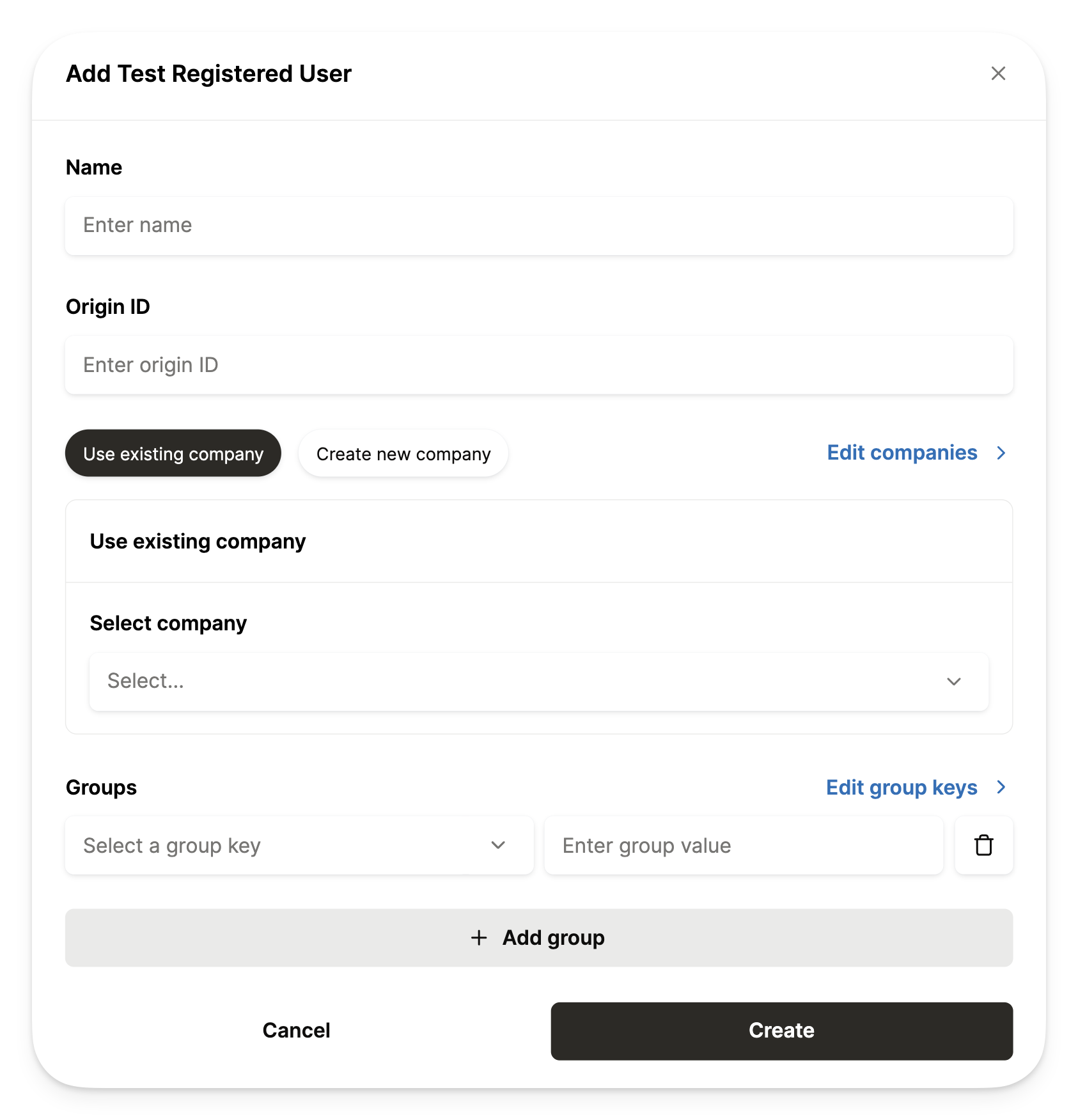
How to create a Test Registered User

  1. Navigate to the Test Registered Users page in dashboard
  2. Click ”+ Add Test Registered User”
  3. Enter the following information:
    • Name of your test user
    • Unique identifier of your test user
    • Company your user belongs to. You can also create a new company to group the user.
    • Additional groupings of the user (optional)
  4. Click “Create”
Add Test User